

Scientific name: Saintpaulia
Saintpaulia are from Africa as their common name suggests. They are nice and small flowering plants with vibrant multiple colors, that brightens up offices and small areas. It is propagated by dividing the cluster of plants into two. Saintpaulias are indoor plants and will not survive on your balcony. Once the flowers die, leaves start turning yellow, then most people discard the plant. These plants are moderately difficult to maintain.
Light
These plants do not enjoy direct sunlight. Put them 1 to 2m away from a window.
Temperature
It is very important that Saintpaulia be kept in a cool room. If the plant is kept in a hot and dry environment, leaves turn yellow.
Watering
These plants are peculiar in the sense that they are irrigated from the bottom rather than from the top. Fill a shallow plate of water under the pot, letting the plant stand freely. After 10-15 minutes the plant would have taken the amount of water needed. Throw out the rest of the water if still not absorbed. Repeat whenever you find the surface of the compost dry. Overwatering will kill the plant.
Be very careful when watering these plants, because any drop of water that accidentally falls on the foliage, will be caught in the hairy leaves causing bacteria invasion and botrytis, which is the decaying of the leaf.
Feeding
Feed fortnightly when in flower. Never spray the leaves with plant food.

Scientific name: Syngonium Podophyllum
Other common names: Goosefoot plant, Nephthytis and Arrowhead vine
Syngonium is a climbing plant, originally from Central and South America. The leaves shape and size vary from young to mature plants, starting arrow shaped later dividing into three lobes forming a goosefoot shape. It can also be grown in water as a hygrophyte. This plant is quite easy to look after. Arrowheads are recommended for beginners.
Light
Syngonium enjoys bright light, but no direct sun. The green variety can tolerate dimmer light intensities, 3m to 4m from a window. Do not expose to direct sunlight as it will scorch their leaves.
Temperature
They prefer normal room temperature (20C to 30C). These plants grow better when placed in a humid atmosphere.
Watering
It is important to keep the potting mix moist but allow the surface to dry out before watering again.
Feeding
Feed fortnightly, with the recommended dose during the active growth phase, which in Egypt is most of the year.
Helpful instructions
Keep in mind these are poisonous plants if ingested, therefore keep away from the reach of pets and children.
These plants can be trained to live in hanging baskets.
Otherwise, cut the long branches back to have a bushier plant.

Scientific name: Rhododendron
Another common name: Azalea Japonica
These beautiful flowering plants are native to Asia, Europe and North America. In nature, these plants bloom in May to June, producing very vibrant and beautifully colored flowers. Naturally flowering seasons are altered by growers in nurseries, to produce flowers off season like Christmas and New year. These shrubs were manicured into beautiful bushes to decorate Japanese emperors’ gardens. Japan has a flower festival celebrating these flowers.
Azaleas are highly toxic if ingested. In Turkey, some bees are deliberately fed on Azaleas to produce a mind altering medicinal honey, called mad honey. These flowering plants are easy to look after, you should be careful if you have kids or pets not to munch on these plants.
Light
Like most flowering plants, these plants will need plenty of light, as far as it is not a direct sun. Put them as close as possible to the window, all the time.
Temperature
Azaleas prefer cool room temperature (15C to 25C). The higher the temperatures, the faster the flowers will bloom and die. These plants grow better when placed in a humid atmosphere.
Watering
It is one kind of a plant that people cannot kill by overwatering. Azaleas just love water.
Feeding
Feed Azaleas at a frequency of 10-15 days, during their flowering season, then every 2-3 week intervals, during their growing season. Stop feeding when no new growth appears.
Helpful instructions
Once flowers are over, prune branches back, shaping the plant to your liking, you can even train it with wires to become a bonsai, both indoors and outdoors.
Do not repot Azaleas while they are blooming, wait until flowers are off. Be careful with the roots since they are very fragile.


Scientific name: Codiaeum
Codiaeum originates from Malaysia and Polynesia. The Croton has magnificent foliage; both in shape and colors. These plants can grow to shrubs outdoors in shady areas giving them the different colors, tints and hues, such as yellow, orange, red, brown and green. They brighten up any room because of their bright colors. These plants are easy if kept outdoors, but becomes moderately difficult indoors.
Light
These plants when indoors require plenty of light to keep the beautiful colors of its leaves. Therefore, recommended to place right next to a window where it gets exposed to direct sunlight for a couple of hours daily. Lack of light, will cause the foliage to lose its bright colors and turn plain green.
Temperature
The Egyptian all year-round weather is ideal for these plants, especially Alexandrian weather. Normal room temperatures of 25C to 35C are beneficial for these plants. Humidity being key for their survival, stand on gravel tray if needed.
Watering
During summer, water well enough to keep the potting mixture thoroughly moist but never allow pot to stand in water. In winter, this plant goes to a semi dormant stage, then only give enough water to keep the mixture from drying out completely.
If the plant is left thirsty the leaves will droop begging for water and will soon revive to its normal, once watered. If the leaves insist on staying drooped, spray the leaves with room temperature water.
Feeding
Feed every two weeks from spring to fall, follow the instructions on the label.

Scientific name: Cyclamen
The Cyclamens originally came from the Mediterranean region. These plants are one of the most beautiful flowerings houseplant. Cyclamens’ flowers come in an array of colors, such as pink, purple, red and white. Cyclamens are difficult to look after and to provide the right conditions for its survival through several seasons, but not impossible. Keep in mind that these are seasonal plants.
Light
These plants do not enjoy direct sunlight. Put them 1 to 2m away from a window.
Temperature
It is very important that Cyclamens be kept in cool rooms. If the plants are in a hot and dry environment, leaves turn yellow.
Watering
These plants are peculiar in the sense that they are irrigated from the bottom rather than from the top. Fill a shallow plate of water under the pot, letting the plant stand freely. After 10-15 minutes the plant would have taken the amount of water needed. Throw out the rest of the water if still not absorbed. Repeat whenever you find the surface of the compost dry. Overwatering will kill the plant.
Be very careful when watering these plants, because any drop of water that accidentally falls on the foliage, will be caught in the hairy leaves causing bacteria invasion and botrytis, which is the decaying of the leaf.
Feeding
Feed fortnightly when in flower. Never spray the leaves with plant food.
Helpful instructions
When flowers die and leaves turn yellow it is very important to cut them back to their corm, to prevent seed formation. Also, gradually withhold water until the corm is completely dormant and put the pot in a dark, cool place like a garage. In mid-September, take the plant outdoors in a lightly shaded place, water it sparingly until corm start shooting again. Most people throw their corms out, once the plant starts dying.

Scientific name: Dracaena
Dracaenas come from tropical and sub-tropical Africa and Asia. They represent a diverse group of plants, with different foliage sizes, shapes and colors. Most Dracaenas are grown in soil but some can be fully grown in water, hence being a hydroponic plant. The Lucky Bamboo, actually being a Dracaena plant growing in water. This group of plants is quite easy to nurse, strongly suggested for beginners.
Light
These plants need plenty of light around 1 to 2m away from a window but no direct sun needed unless it is in the winter season. Or for very short periods in summer.
Temperature
Ideally, Dracaenas like from intermediate to warm environments (18C to 35C). Although their leaves will droop and eventually will turn yellow and fall off in low temperature. Egyptian short, cold winters, will do no everlasting harm. Humidity is needed, therefore stand plant on gravel tray or damp pebbles.
Watering
Although, this plant needs to be watered regularly during the growing periods. Be careful not to overwater. Allow the surface of compost to dry in between watering.
Feeding
Feed once every two weeks from March to October. Use either liquid fertilizer or place slow release pellet in the soil, do not use a foliage feed as it affects the Dracaenas leaves.
Helpful instructions
Variegated varieties of Dracaena, will be needing higher intensities of light than its green cousins.

Scientific name: Dieffenbachia
Dieffenbachia originally comes from Tropical America. This plant is known for its foliage, dark green with white blotches. They are called Dumb Cane because of their milky sap, which contains a poisonous compound called strychnine, when ingested makes you speechless, similar to alum. It’s not the kind of plant you should buy if you have toddlers, or pets that will chew on them. Dieffenbachia is considered moderately easy to look after.
Light
Bright light is required for these plants, but shaded from direct sun. Place them 1-2m away from a window. The color of the plant will suffer if it has poor light conditions losing its characteristic white patches, and turning into pale green.
Temperature
Dieffenbachia as a houseplant enjoys warm rooms (20C to 30C). It is important to keep a high level of humidity, therefore let it stand on gravel tray.
Watering
Poke the compost with your finger, approximately 2-3 cm deep, to know if the plant is thirsty. Wait for the soil to dry between irrigations. Keep compost gently moist at all times. Be cautious, when watering, that water doesn’t touch the thick stem of the Dieffenbachia, not to take a chance with Botrites – decaying bacteria. Do not spray the leaves, for the same reason.
In winter, be careful not to overwater the plant.
Feeding
These plants should be fed routinely every 15 days, in the growing season.
Helpful instructions
Being very fragile, these plants should be kept away from places, that people can accidently bang into. For this reason, place plant away from curtains and small walkways.

Scientific name: Bromeliaceae
Bromeliads come from Central and South America. This family of plants mostly living on top of other trees in the wild. These peculiar plants have a very small root system & get their water supply by collecting rain water. Rain drops on individual plant’s leaves eventually funneling down into the middle, where the flower grows. Some can even live entirely on the presence of high humidity in nature. Most bromeliads have exotic looking flowers with vibrant colors. Which has a long life of few months. They are slow growing plants, edible pineapples being one of them. Bromeliads defer from other houseplants in the sense that the mother plant dies after having one or two babies simultaneously, and in turn baby plants continue the cycle. All bromeliads are easy plants to look after.
Light
Most Bromeliads need good light (1m to 2m away from a window), except for Neoregelias which can tolerate direct sun.
Temperature
Optimum temperature should be between 15C-25C. Humidity is needed for these plants; stand on gravel tray if needed.
Watering
Keep media moist but not soggy; allow the top 3 cm of compost to dry out, in between waterings. Bromeliads need one tablespoon full of water in the funnel where the flower grows. Wait until water in funnel dries up completely before adding more, otherwise the flower will rot.
In winter, these plants will need less water but make sure the compost does not dry out completely.
Feeding
During growing periods (summer) these plants should be given a diluted feed every three to four weeks.
Helpful instructions
Never repot Bromeliads. Only if the top of the plant becomes heavier, because of the flower or the pineapple, move it into a bigger pot without discarding the original one.
It is very normal for the flower to die and rot, so just discard the flower.
After the babies grow, do not remove the mother it will died and fall off automatically.

Scientific name: Gardenia Jasminoides
Other common names: Cape Jasmine
Gardenia is a family of plants that are native to tropical and subtropical Africa and Asia. These are originally outdoor shrubs, in semi shaded spots. Which can be trained to live indoors as well. Gardenias are sought after for their highly aromatic and fragrant flowers. Nonetheless, these plants have dark green leaves, all year round, which make them beautiful indoor plants. Gardenias are moderately difficult to look after, for their peculiarity in their optimum needs.
Light
Gardenias, originally being outdoor plants, will need very high intensities of direct light indoors. Place plants maximum 1m away from a window or as close as possible. Sunny indoor positions are very much appreciated by these plants.
Temperature
Cool Egyptian summers, are ideal for these flowering plants. In winter, make sure temperatures do not fall below 15C.
Water
Do not overwater these plants, specially whenever they have flower buds ready to bloom. When buds or leaves turn black and start dropping is a definite sign of overwatering. Do not overwater these plants. Long droughts will make all buds to fall off as well.
Feeding
Feed fortnightly during the active growth period from May to late September.
Helpful instructions
Iron supplements help grow these plants better. Deficiency of iron can cause some leaves to turn yellow.
Flower buds might drop due to: over watering, under watering, low humidity, insufficient light, temperatures lower than 15 C or very high temperatures above 38C. So be attentive to find out which cause being the reason.

Scientific name: Hydrangea
Other common names: Hortensia
Hydrangeas are native to Asia and the Americas. These beautiful plants, bloom in spring, consisting of a cluster of small star-shaped flowers, grouped together, resembling an umbrella, known as “Umbel”. Hortensias are available in white, green, blue, lilac, purple and many shades of pink. In nature, some species are quite large in size, while others remain small shrubs. These flowering plants are very popular as gift items, since they look cheerful and beautify any space. These plants are not the easiest plants to grow at home, but nevertheless people buy them knowingly that they might end up by discarding them after the flowering season. The bright clusters of flowers attract customers and makes them buy, the same way they buy cut flowers.
Light
These plants need strong light around 1 to 2 m from a window, and will enjoy 1 hour of direct sun a day.
Temperature
These plants enjoy cool to warm temperatures. Heat over 35 C Will not be appreciated by Hydrengias.
Watering
Hydrangeas need to be watered regularly and thoroughly well, never letting their soil to dry completely. Otherwise, the leaves and branches droop quite fast. If this happens, spray the leaves with water, so they achieve the right turgidity swiftly. Keep soil moist at all times, drying out the soil can seriously harm the plant, and sometimes might not recover at all.
Feeding
Feed plants every 10 days, during growing season, April to September. Use plant food, high in potassium before flowering.
Helpful instructions
When the flower heads turn brown, or die carefully cut them off.
Most people discard the plant after the flowers die. Rather than discarding the plant, we recommend you, to plant them outdoors in a garden; helping them grow back to shrubs.
The color of the flowers changes from pink to blue, according to the acidity or the alkalinity of the soil. They can be easily interchangeable.

Scientific name: Dracaena Sanderiana
Originally from Africa, Lucky bamboo is the commercial name of the Dracaena Sanderiana plant, which are grown in water. This plant is considered lucky in Feng Shui, hence given the name of Lucky Bamboo. Always bought in odd numbers for better luck. This plant is easy to look after.
Light
These plants need a moderate intensity of light, 1.5m to 2m away from a window. They do not appreciate direct sun.
Temperature
Optimum temperature should be between 20C-30C
Watering
In a vase, one-third of the stems should be submerged in water. Once water is evaporated for a couple of centimeters top it up to its previous level. Preferably use water left aside for 24 hours to get rid of the florin and chlorine. Change the water and clean the vase only when foul smell occurs.
Feeding
These plants can be perfectly alright with our non-filtered tap water used at home. An additional supplement of feeding can be a treat. Use feeding specially for hydroponics. Any other feeding should not be used at all.
Helpful instructions
When foul smell occurs take the bamboos under running water for a couple of minutes to wash out decaying roots and algae.
Remove any bamboos showing yellow leaves or yellow stems, put them in a quarantine, so that no infection spreads.
Never put cut flowers along with the bamboos. Remove any fallen leaves from the water, not to attract bacteria.

Scientific name: Pachira Aquatica
Common names: Guiana Chestnut, Water Chestnut and Malabar Chestnut
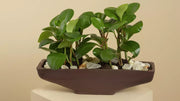
Pachira is originally from Latin America. The money plant is very ornamental, it has shiny green palmate leaves, often in clusters of 5 to 7. A pot combines several small trees with their trunks braided together. Not only is it decorative, but also believed to bring luck and fortune into your home, it is a Feng Shui tree. Money trees are easy to look after, as they do not need any special care.
Light
Pachira enjoys plenty of light, 1-1.5m away from a window, try avoiding direct sunlight in hot summers.
Temperature
Intermediate to warm environment is ideal for this plant (20C-35C).
Watering
Irrigate the plant when compost feels dry but do not overwater, as this will kill the plant.
Feeding
Feed every 10-15 days as long as new growth can be spotted.

Scientific name: Phalaenopsis Orchid
Phalaenopsis Orchids come from East Asia and the western Pacific. This family of plants are sought after because of their beautiful and long-lasting flowers. With thick leathery leaves which stay green all year round. It makes a great gift in all happy and sad occasions likewise. Phalaenopsis plants flower periodically, and have very few pests and illnesses. In Florabel, we have these plants all year round, because it is one of the hardiest and the easiest orchids species that do very well in Egypt. This family of orchids is quite easy to look after, and ideal for beginners as well as kids.
Light
It needs bright indirect sunlight, maximum distance being 1.5-2m from a window. If ever, a maximum of one hour of direct sunlight, would be acceptable by the plant.
Temperature
These plants prefer our Egyptian warm temperatures and enjoys humidity.
Watering
Water Phalaenopsis moderately, allowing the water in between the roots to dry out, before re-watering. These plants come in transparent pots, so you can peep-in to see the drops of water entangled in-between the roots. Keep the potted plant in a ceramic cachepot all the time, to help keep the plant from toppling, and also to help in watering.
To water this orchid, intentionally, over-water the plant for a period of 15-20 minutes. And since the transparent plastic pots have holes at the bottom, next raise the plastic pot from its ceramic container, discard the excess water, and return the potted-plant back to where it belongs. Be careful not to get any water on the flowers as this will affect its life span.
Helpful instructions
Once the flowers die and flowers spike turns brown, get it to Florabel for us to cut in order to new flowers.
In nature these plants are epiphytes on big trees, anchoring themselves in the ‘V’ of branches, that’s why their roots are small. Phalaenopsis are grown in special media, mimicking their natural environment. Do not repot these plants under any circumstances.
These orchids have aerial roots, that help collecting humidity from the atmosphere. Never try to insert them into the pot. You can cut them back only if they die or decay.

Scientific name: Aracaceae
Most palms, as we all know, are outdoor plants in hot countries. Very few can survive indoors giving the extra elegance and beauty to their surroundings. They are not the easiest to look after, but can be done by following our instructions carefully. Since most type of palms need very similar care, we have grouped them together.
The easiest being the Chamaedorea, commonly known as parlor palm. Considered a dwarf palm, with bamboo like stems, originally from Central and South America.
The most elegant of indoor plants being the Howea Forsteriana, commonly known as Kentia. A bit towards the expensive side, but worthwhile. Originally from Lord Howe Island in the Pacific, of which Kentia is the capital. There are only two kinds of Kentia, Howea Forsteriana and Howea Belmoreana.
Chrysalidocarpus also known as Areca are from Mauritius. These palms are highly ornamental. The leaves are arching and have an unusual yellow tinge on them, making them sought after by plant lovers. Areca are more difficult compared to the first two.
Cycas Revoluta commonly known as Sago palm or Dragon food, is a palm that lives fully outdoors. Thus, it could live happily in a pot in the balcony, no matter how elevated your house is. These plants have separate gender of male and female. Males grow new layers of leaves all the time while females do not in order to make room for their seed cone. It grows best in sandy well drained soil. This palm is an easy one to look after.
Light
Palms like strong bright light. As close as possible to the window, with a daily direct sunlight for a couple of hours, will give them a denser color.
As mentioned above Cycas needs to be outdoors all the time enjoying the full sunlight.
Temperature
Palms being native of hot climates countries will enjoy the warm temperatures in any house (30 C to 35 C). These plants will also tolerate a moderate to normal room temperature.
Watering
These palms need to be watered well, to keep the potting mixture thoroughly moist, but neither allow the pot to stand in water nor completely dry out. Less water is needed in winter.
Feeding
In the growing season (March to October) feed the plant every two weeks as recommended dosages labeled. Stop feeding totally in winter.
If you intend to keep the grape like flowers of some of the palms, feed them more often; every ten days.
Helpful instructions
Some palms will give flowers that look like miniature grapes, which will exhaust the plant. Cutting them off at its juvenile state will help the palm to regain its strength.
Be careful when repotting these plants since they are very sensitive to the chemical composition of the soil. Making sure the acidity and alkalinity to stay constant from one pot to another. Chemistry of soil can be disturbed when using different brands of peat moss or changing the composition of the compost. Hence, repotting should be done only in extreme needs in the months of April or September.

Scientific name: Spathiphyllum
Spathiphyllum is originally from Central and South America. It produces beautiful white flowers for most of the year. It does very well in homes and offices. Peace lilies are highly recommended because of their superior ability to purify the air indoors. Spathiphyllum is one of the rare house plants that flower indoors over and over again, without the excessive need for light or care. This plant is an easy plant as there is no specific care required.
Light
Medium indirect light is enough to satisfy a Spathiphyllum.
Temperature
This plant does well at a normal room temperature (20C to 30C). These plants grow very well in Egypt.
Watering
Water when compost feels dry, after poking for a depth of 3cm with your finger. Never overwater these plants. If they are left thirsty for a long period of time, leaves droops, and foliage will need to be sprayed with water, more than once, while watering the soil.
Feeding Feed once every 2 weeks during the summer.

Common name: Radiator plant and American baby rubber plant
The origin of the radiator plant is from the Amazon region and South America. Pepperomias have more than 1000 known species. They are compact, small perennial epiphytes, and in the wild they grow on rotten wood. Cuttings from branches can grow both in soil and water. Although it may be tempting to think of Peperomias as succulents, due to their thick, slightly succulent leaves, but that will be a mistake because they generally prefer higher humidity, and more water than most succulents. These plants are attractive and give bizarre looking flowers, like spikes. Peperomias are relatively easy to grow.
Light
The green varieties of Peperomias do well in low light (2m to 3m away from a window), although they will tolerate medium or even bright light. But the variegated ones will need more light (1.5m to 2m from a window), medium to high light but definitely no direct sunlight; as this may cause leaves to lose their coloration. As a general rule, variegated foliage requires more sunlight than green ones.
Temperature
Aim for 20 C to 30 C in any room and provide relatively high humidity for this plant, by setting the pot on a gravel tray filled with water.
Watering
American rubber plants should be watered infrequently, wait until the top 1 to 2 cm of soil have dried out.
Feeding
You should feed the plant every 3 to 4 weeks as long as you see it growing, usually March to September.
Helpful instructions
Peperomia plants do enjoy confined small containers, same like cacti and succulents.
A positive aspect of Peperomias, is that they purify air, according to NASA research, reducing the levels of formaldehyde and other toxins from the air we breathe.

Scientific name: Philodendron
Philodendron is found in Central and South America. The foliage varies in shape from arrow to heart shaped with leathery dark glossy green leafs of different sizes. Some have red color. They are bushy or climbing plants, the latter often needs support, ideally of a moss stick. It can also be grown in water as a hygrophyte. They are very hardy plants; they do well in most houses, highly recommended for beginners.
Light
Philodendrons prefer indirect or gentle shade. Do not expose to direct sunlight. 2-3 m from a window.
Temperature
Must be placed in a room with an intermediate to warm temperature. (20C-30C)
Watering
Water the plants whenever the compost feels dry.
Feeding
Feed every two weeks during the growing season. Which in Egypt is most of the year.

Scientific name: Euphorbia Pulcherrima
Other common names: Christmas star, Christmas flower, Christmas plant, “Bent El Konsol” in Arabic
Poinsettia is native to Central America. Popularly known as Christmas Flower or Christmas Plant. At Christmas time, the top green leaves of Poinsettia change their original color into red, pink or white. These leaves are falsely knowns as “flowers”, while the real flowers are the small yellow ones at the center. In their natural environment, Poinsettias change their colors in late January to February. But to be sold commercially as Christmas flowers, they undergo certain hormonal treatments by the growers; to force the plant to “flower” before their season.
Poinsettia are commonly hyped and exaggerated as poisonous plants, though they rarely are. You should be careful if you have kids or pets not to munch on these plants, since they contain, a white milky sap, that can cause harm.
Light
Poinsettias need good natural lighting. Direct sun or drafts not being appreciated by these plants. Most people like to decorate their homes at this period of time, by placing them anywhere, as part of Christmas decorations, not considering the plants demands. While you have to keep them as close as possible to the windows.
Temperature
Winter warm room temperatures are ideal for these plants (18C-25C). Keep them away from heaters.
Watering
Keep the compost moist but not wet. Check the water in the soil by poking your finger 2-3 cm deep.
Feeding
Feed every 2 weeks until the plant does not produce any new leaves, going dormant.
Helpful instructions
After Christmas is over, new green leaves will appear and the colored ones will drop off, including the yellow flowers. Most people discard the plants at this stage, thinking that they are dying. Do not give up, keep the plants in their same position until the following year, since this is a natural phenomenon. Another solution would be to plant them outdoors in a garden; helping them grow to an amazing 1.5m high the following year.

Scientific name: Scindapsus aureus or Epipremnum aureum
Other common names: Money plant, Devils Ivy, Silver vine and also known as “Bootus” in Egypt
The Pothos was introduced from South-East Asia. This climbing plant is allied to the Philodendron; the foliage is heart shaped. The bright green leaves can be variegated with white or yellow. Can be grown in water as a hygrophyte. In tropical areas like Hawai, their leaves can grow as big as 60 cm of diameter. This plant is easy to nurse, recommended for beginners as well as children.
Light
Pothos can tolerate dimmer light but grow healthier when placed in well-lit rooms with brighter intensity of light. Place maximum 3-4m away from the light source.
Temperature
From moderate to warm room temperature is what these plants like (20C to 35C). Egyptian weather being perfect for their growth.
Watering
If Pothos is planted in compost or any media, it does not like to be overwatered. Nevertheless, it can live in water for an indefinite time, without needing to be transplanted into a soil. This is can be achieved, because morphologically water roots are totally different than soil roots. Allow the soil to dry-out between watering.
Feeding Feed every 2 weeks half the recommended dose during the active growth phase, which in Egypt is most of the year.

Scientific name: Maranta
Maranta originates from Tropical America. This family of plants has very ornamental and beautiful foliage; with different shades of green, purple and some of them have thin lines. They are known as Praying Plant because some varieties in this group have a tendency of folding their leaves at night. They are moderately easy to grow in Egypt in winter times, but our summers’ high heat, causes harm to the plant, leaves get scorched easily.
Light
Unlike other colored foliage plants, which need high intensity of light, these plants can tolerate shady places, 2-3 meters from the window. Never expose to direct sunlight as it will damage the leaves.
Temperature
Maranta thrives in a warm and humid atmosphere, but not the hot weather of over 35 C.
Watering
Irrigate the plant when compost feels dry, do not leave pot standing in excess water, not to rote and decay.
Feeding
Feed plant half a dose, twice a month, during the growing phase.

Scientific name: Yucca
Other common names: Spanish bayonet and dagger plant
Yuccas originally come from Mexico and Central America. These exotic looking plants have sword-shaped leaves giving it its common name. They can live indoors as well as outdoors. The Yucca plants are very hardy, easy to look after and require a minimal amount of care.
Light
Yuccas need the most light possible, it can also tolerate direct sunlight.
Temperature
This plant can adapt and tolerate any temperature. They can also stand very dry atmosphere.
Watering
As an outdoor plant, it needs plenty of water during the summer but do not overwater. As a pot plant, be careful not to overwater, because Yuccas should be kept fairly dry during the winter. If over watering persists, root rotting will occur and the stems will turn soggy indicating its death.
Feeding
Feed weekly from April to October.
Helpful instructions
To propagate a yucca its quite easy, sow the main wooden branch at any point, and leave it out for few day in a sunny spot until the bottom part dries-up. Plant in a well drained soil containing sand.

Scientific name: Ficus Benjamina
Ficus, the genus to which the edible fig tree belongs, is abundant throughout most of the world with many different varieties. This family of plants is amongst customers first selection. Their appearances do vary greatly from one kind to another. They can live outdoors as well as indoors.
Ficus Benjamina is the most common one available in our store. Commonly known as weeping fig, because of its tendency to shedding (weeping) lots of its leaves, as a sign of unhappiness to its recently changed position. Some have braided stems, to be used as focal points, in houses and gardens alike. Moderately difficult to look after, due to its peculiarity for choosing the right spot.
Light
Good light, being as close as possible to a window. Inadequate light makes leave fall in abundance.
Temperature
They like warm temperature (20C to 35C).
Watering
Weeping figs do not like being overwatered, as this will cause the leaves to turn yellow and fall. Make sure to water only when the compost feels dry.
Feeding
These plants can be fed regularly, as shown on labels of plant food. Egyptian weather helps them to grow almost all year round.

cientific name: Zamioculcas Zamiifolia
Other common names: ZZ plant and Zamia in Egypt
Zanzibar gem is native to eastern Africa. These plants have waxy smooth leaves, almost looking artificial. They are very popular houseplants. Based on NASA study, these plants have the ability to purify the air by removing toxins such as xylene, toluene and benzene. ZZ plants are toxic, if ingested, therefore avoid close contact by pets and children. These plants are easy to look after and are perfect plants for beginners.
Light
Zamiifolia plants could live in shady areas, place maximum 1m to 2m away from a window.
Temperature
Zamias like moderate temperatures of 20 C to 35 C, for indoors. If planted outdoors it should be in a shaded area not to exceed acceptable temperatures.
Watering
ZZ plants do not like to be overwatered at all. Allow the soil to dry out well between each watering.
Feeding
Feed once every 2-3 weeks, according to your irrigation.
Helpful instructions
If any stem is loose pull it out and plant it again in another pot, thus having a new plant.